
How to Evaluate Fractional COO Services in Singapore
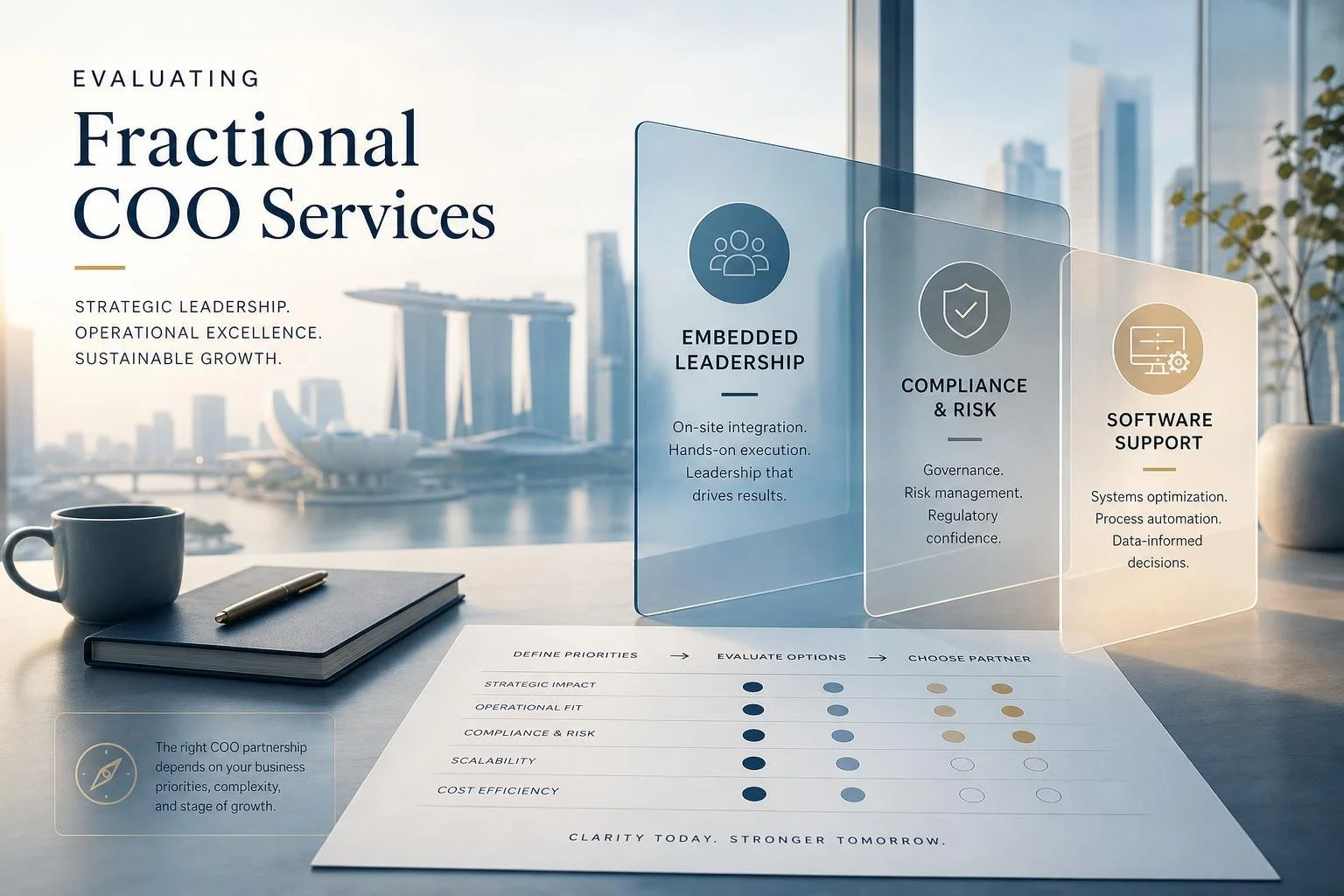
The fractional COO market in Singapore has matured enough that most services sound similar on paper. The real differences emerge when you probe how the engagement actually runs - who delivers the work, what they own, and how accountability is structured. For a scaling startup, choosing the wrong model costs more than choosing no model at all.
Why Evaluating a Fractional COO Service Is Harder Than It Looks
The challenge is that every fractional COO service in Singapore leads with the same language: experienced operators, execution-led, senior support, outcomes-focused. The positioning is nearly identical across the market. What differs - significantly - is the reality behind it.
Some services genuinely embed senior operators inside the business's operating rhythm, own the operating cadence, and are accountable for whether execution improves. Others operate as periodic advisors who attend key meetings, provide input, and leave the implementation to the founder's team. Both describe themselves as fractional COO support. Only one of them solves the problem a scaling startup actually has.[1]
The evaluation mistake to avoid: comparing fractional COO services on credentials and case studies alone. The relevant question is not what the operator has done before - it is what the engagement will own once it starts.
The Evaluation Criteria That Actually Matter
When evaluating fractional COO services for a scaling startup in Singapore, five criteria separate the operators from the advisors.
- Who delivers the work - specifically.
Not the firm's general capability. The individual operator. Have they built and fixed operating models inside technology scale-ups - not observed them, not advised on them? Ask for specific examples: what was broken, what did they build, what changed? - What does the operating cadence look like?
Monthly check-ins produce monthly visibility at best. A fractional COO embedded at operating level is in the business weekly - running operating reviews, tracking accountability, and closing the gap between decisions and execution. Ask precisely how often the operator is in the business and what they own in each interaction. - What does the engagement own versus advise on?
The clearest test: ask who is accountable if the operating model does not improve. An operator owns that accountability. An advisor produces a view on why it has not improved. - How does the COO work with finance and GTM?
Operations does not run in isolation. A fractional COO who works only on internal process without connecting to sales cadence, financial reporting, and GTM execution is solving half the problem. The most effective engagements cut across all three functions. - How does the engagement end?
A well-structured fractional COO engagement builds operating infrastructure the team can run independently - not a dependency on the operator. Ask how previous engagements have concluded and what the business was able to do at the end that it could not do at the start.
How Different Fractional COO Models Compare
The Singapore market offers several distinct models for fractional COO support. They are not interchangeable - each suits a different stage and a different type of operational problem.
| Model | How the engagement runs | Accountability structure | Best fit |
|---|---|---|---|
| Fractional operator e.g. Salamander Advisory |
Embedded in the operating rhythm - weekly cadence, cross-functional ownership, accountable for outcomes | Owns operating performance - not just the process design | Scale-ups where execution has fallen behind strategy and the founder needs operating infrastructure built fast[1] |
| Independent fractional COO | Varies widely - typically one or two days per week, focused on a defined operational scope | Accountable for the defined scope; broader operating accountability depends on the individual | Companies that need a specific operational fix and have a clear brief |
| Operations advisory retainer | Monthly or quarterly touchpoints, input on operating decisions, occasional process reviews | Advisory - accountable for the quality of input, not for execution outcomes | Established businesses that need senior operational perspective but are not in an active scaling phase |
| Interim COO (full-time, fixed term) | Full-time embedded, owns the entire operations function for a defined period | Full executive accountability - closer to a permanent COO than a fractional model | Post-acquisition, crisis stabilisation, or leadership transitions requiring full-time presence |
At Salamander Advisory, our Operations practice sits firmly in the first column. The engagement is built around weekly operating cadence, cross-functional accountability across operations, GTM, and finance, and a clear definition of what the business will be able to do independently once the engagement concludes.[1]
Questions to Ask Before Signing an Engagement
The proposal stage is where services differentiate themselves on paper. The following questions cut through the positioning and reveal how the engagement will actually run.
- Who specifically will run the weekly operating cadence? If the answer is unclear or the individual changes based on availability, the accountability structure is too loose for a scaling startup.
- What does the operating rhythm look like in the first 30 days? A credible fractional COO service should be able to describe this precisely - not in generalities.
- What have previous engagements left behind? Ask for specifics: what operating infrastructure exists in a previous client's business that did not exist before the engagement? If the answer is a framework or a document, that is advisory. If the answer is a working cadence and a team that can run it, that is an operator.
- How is the engagement scoped - by time or by outcome? Time-based scoping tends to produce time-filling. Outcome-based scoping produces operating improvements.[2]
If you are evaluating fractional COO options for a scaling startup in Singapore and want to understand how Salamander Advisory's Operations practice approaches the work, speak with Salamander.
Questions on Evaluating Fractional COO Services
What makes a fractional COO service reliable for a scaling startup?
Reliability comes from accountability structure, not credentials. The most reliable fractional COO services are the ones where the operator owns a real executive remit - not just a defined scope of deliverables. That means being present in the operating rhythm weekly, accountable for whether execution improves, and able to work across finance, GTM, and operations simultaneously rather than in a single functional silo.[1]
How much should a fractional COO engagement cost in Singapore?
Cost varies significantly based on the level of embeddedness, the scope of the operating remit, and the seniority of the operator. Operator-led engagements with weekly cadence and cross-functional accountability are priced to reflect genuine executive depth. Advisory retainers with monthly touchpoints are priced lower but deliver a fundamentally different level of support. Comparing prices without comparing what the engagement owns is not a useful evaluation.
How long should a fractional COO engagement run for a Series A startup?
Long enough to build operating infrastructure the team can sustain independently - typically six to twelve months for an initial engagement, depending on the complexity of the operating model and how much needs to be built from scratch. The engagement should have a clear definition of what success looks like at the end, not just a rolling monthly commitment with no defined outcome.[2]
Is a fractional COO the same as an interim COO?
No. An interim COO is typically full-time for a fixed term - closer to a permanent executive hire than a fractional model. A fractional COO operates on a defined weekly cadence across a specific operating remit, usually alongside an existing team rather than replacing an absent executive. The interim model suits post-acquisition or crisis scenarios. The fractional model suits scale-ups that need operating depth without full-time executive cost.